The Gut Connection: How One Client's Skin, Energy, and Cravings Turned Around at Once
When clients come to me, they usually think they're dealing with one problem. Acne. Fatigue. Bloating. Sugar cravings. They've often seen a specialist for each — a dermatologist for the skin, maybe a doctor for the fatigue, and they've quietly given up on the cravings because "that's just willpower."
But in my experience, these symptoms are rarely separate stories. More often, they're different chapters of the same one — and that story usually starts in the gut.
Here's a real example.
Where Alex started
Alex had been dealing with acne since she was 13. By the time we started working together, she'd been through two rounds of Accutane, a long list of antibiotics, and pretty much every topical on the market. Nothing held. On top of that, she was constantly tired and foggy — no matter how much sleep she got.
That combination isn't a coincidence. It's a pattern I see often, and it points toward the gut.
Why the gut shows up on your skin
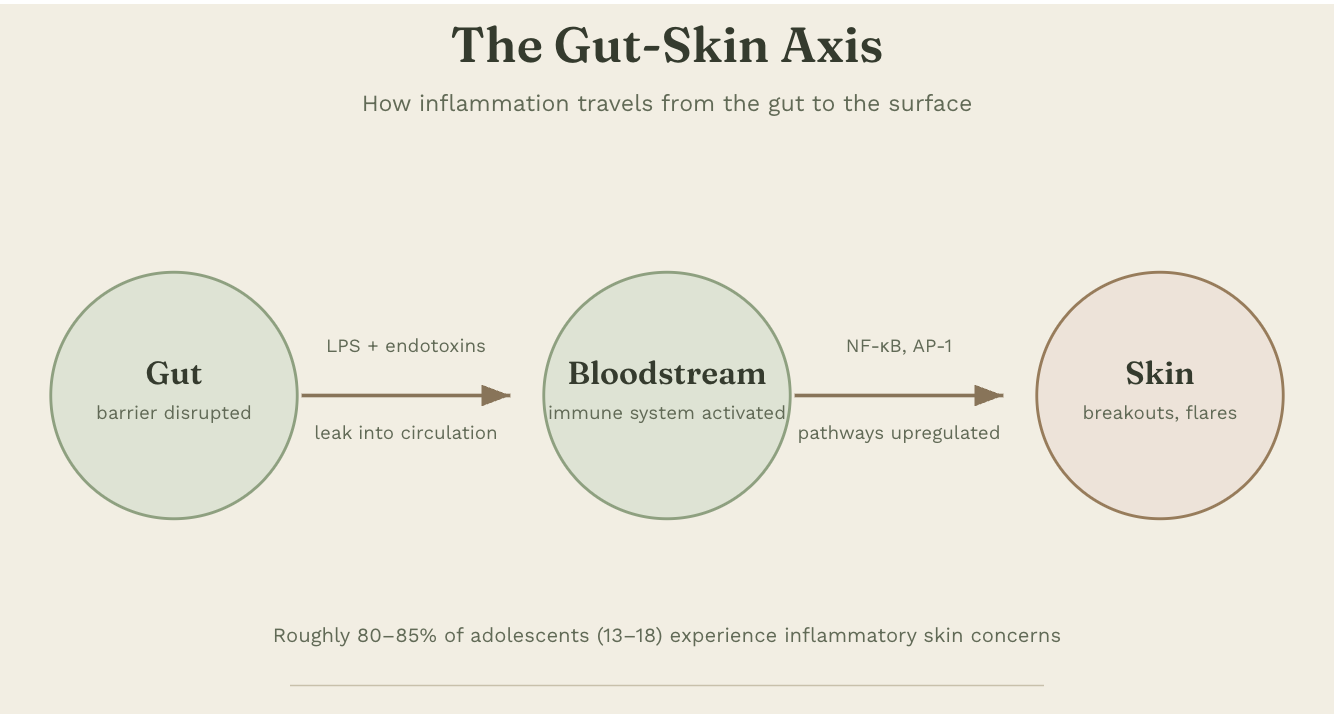
Your gut and your skin are in constant conversation — researchers call this the gut-skin axis. When the gut environment is disrupted, inflammatory signaling pathways (like NF-κB and AP-1) get upregulated. Those signals don't stay local — they travel systemically through the bloodstream and can show up on the skin as inflammatory acne lesions: papules, pustules, cysts.
Part of what drives this is gut barrier integrity. When the gut lining becomes more permeable, compounds called lipopolysaccharides (LPS) — endotoxins that are normally kept contained — can leak into circulation. That leakage keeps the immune system on high alert, which shows up as ongoing skin flares. This is also why probiotics and postbiotics are often part of a gut-focused approach: they help lower circulating LPS and calm that immune reactivity.
It's also worth naming how common this actually is — inflammatory skin concerns affect roughly 80–85% of adolescents between 13 and 18. Alex's acne starting at 13 isn't an outlier story; it's a window that opens for most people, and for many, it just never fully closes.
This is a big part of why purely topical or antibiotic-based approaches to acne often work for a while and then stop working, or come with side effects — they're treating the skin as the source, when the skin is often just where the problem becomes visible.
Why the gut shows up as fatigue and brain fog
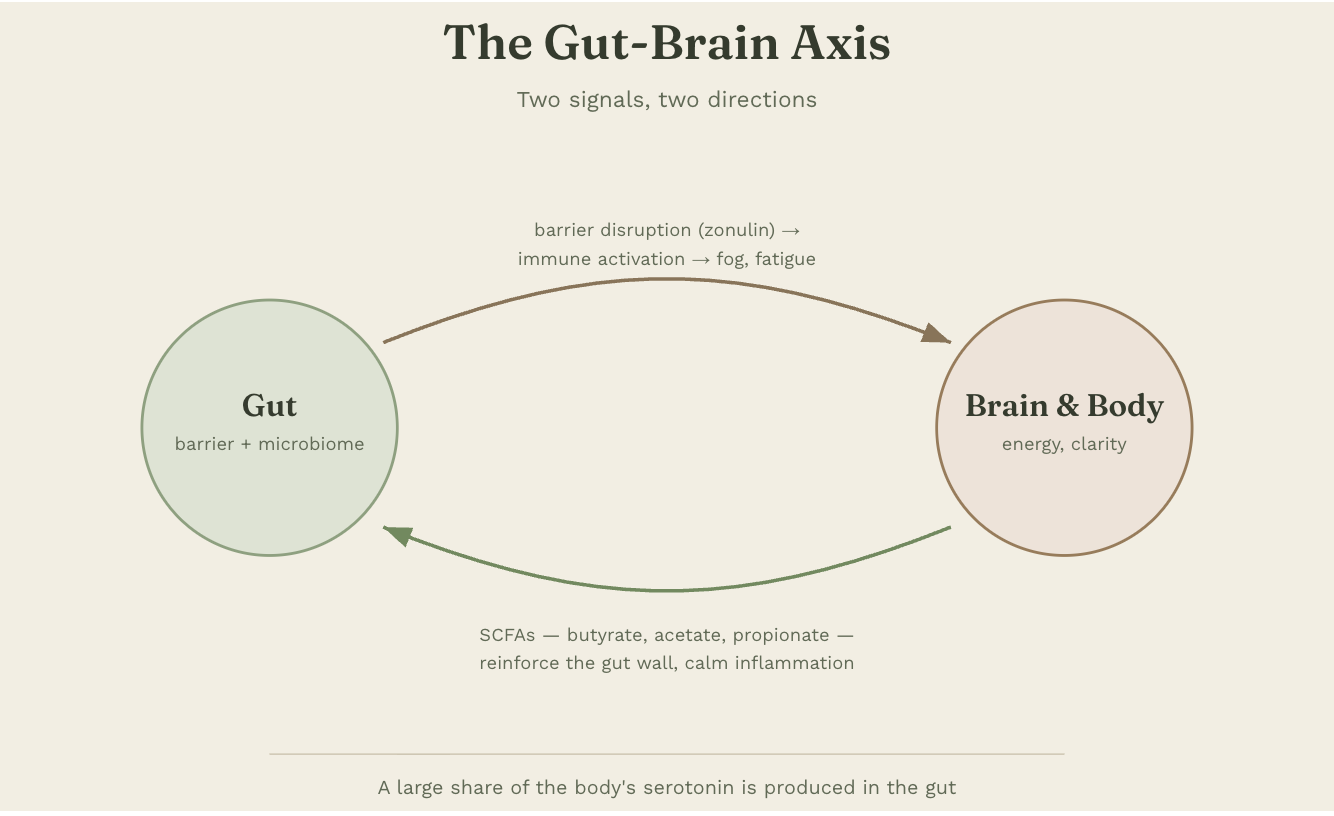
The gut doesn't just affect how you look — it affects how you feel. A large percentage of your neurotransmitters, including a big share of your serotonin, are produced in the gut. So when the gut mucosal barrier is disrupted — something researchers can track with markers like zonulin — it triggers systemic immune activation. That low-grade, ongoing inflammation doesn't just stay in the gut; it affects neural signaling too, which is part of why it can chip away at cognitive clarity, resilience, and steady energy.
On the flip side, a diverse, healthy gut microbiome produces short-chain fatty acids (SCFAs) — things like butyrate, acetate, and propionate. These aren't just byproducts; they're signaling molecules that help reinforce the gut wall and lower the overall neuroinflammatory load on the body. More SCFA production generally means a calmer immune system and a clearer head.
That's often why fatigue and brain fog show up alongside skin and digestive issues — they're downstream of the same root cause, not three unrelated complaints.
Why the gut shows up as cravings and bloating
Bloating is usually the most obvious sign that something in the gut is off — but it's also one of the most ignored, because people assume it's just "how their stomach is." In reality, it's often a visible symptom of the same barrier and inflammation issues driving the skin and energy problems.
Sugar cravings are connected too. Certain gut bacteria thrive on sugar, and an imbalanced microbiome can quite literally drive cravings for the foods that feed it — pulling the system further from the SCFA-producing bacteria that calm inflammation, and closer to the kind that feed it. That makes cravings feel less like a lack of discipline and more like a biological feedback loop.
What changed for Alex
Instead of treating Alex's acne, fatigue, and cravings as separate problems, we worked on the gut — the thing connecting all of them: supporting the gut barrier, easing that systemic inflammatory load, and giving her microbiome what it needed to produce more of those calming SCFAs instead of feeding more cravings. Importantly, we didn't do it by stripping her diet down to nothing. She'd been told for years that she'd have to cut out gluten and dairy to see any results. We didn't go that route, and she didn't have to.
In her words:
"I had been struggling with acne for years, since I was 13 — Accutane twice, every antibiotic, every topical you can think of. I was exhausted all the time with brain fog, no matter how much I slept. Since working with Alexa, my skin has pretty much cleared, my bloating is gone, and my energy feels normal again. I feel confident not wearing makeup, and my sugar cravings are in control. She never forced anything on me that I wasn't comfortable with or couldn't afford — I really didn't want to cut out gluten or dairy like everyone said I'd have to, and I didn't. She's the first person who didn't make me feel crazy and actually listened to what I was dealing with. I would recommend her to anyone. I am so appreciative of her."
Her skin cleared. The bloating resolved. Her energy came back. The cravings settled down. And she got there without an extreme elimination diet — because the plan was built around her gut, her budget, and her actual life.
The takeaway
If you've been treating your skin, your energy, and your cravings as three unrelated battles, it might be worth asking whether they're actually one.
The gut is often the thread connecting symptoms that seem to have nothing to do with each other — and addressing it can move all of them at once, instead of chasing each one separately.
This post reflects one client's experience and general information about the gut-skin and gut-brain connection. It isn't medical advice, and individual results vary.
References: Yoon JY, Kwon HH, Min SU, Thiboutot DM, Suh DH. Epigallocatechin-3-gallate improves acne vulgaris by modulating intracellular molecular targets and inhibiting Propionibacterium acnes. J Invest Dermatol. 2013;133(2):429-440. doi:10.1038/jid.2012.292Purdy S, de Berker D. Acne vulgaris. BMJ Clin Evid. 2011;2011:1714. Published March 24, 2011.Zheng Y, Zhang Z, Tang P, et al. Probiotics fortify intestinal barrier function: a systematic review and meta-analysis of randomized trials. Front Immunol. 2023;14:112653. doi:10.3389/fimmu.2023.112653Boschetti E, Caio G, Cervellati C, et al. Serum zonulin levels are increased in Alzheimer’s disease but not in vascular dementia. Aging Clin Exp Res. 2023;35(8):1733-1740. doi:10.1007/s40520-023-02463-2Rossi JF, Lu ZY, Massart C, Levon K. Dynamic immune/inflammation precision medicine: The good and the bad inflammation in infection and cancer. Front Immunol. 2021;12:595722. doi:10.3389/fimmu.2021.595722Mekhora C, Lamport DJ, Spencer JPE. An overview of the relationship between inflammation and cognitive function in humans, molecular pathways and the impact of nutraceuticals. Neurochem Int. 2024;181:105900. doi:10.1016/j.neuint.2024.105900Wegh CAM, Geerlings SY, Knol J, Roeselers G, Belzer C. Postbiotics and their potential applications in early life nutrition and beyond. Int J Mol Sci. 2019;20(19):4673. doi:10.3390/ijms20194673