Supporting the Luteal Phase: A Nervous-System-First Approach to PMDD
If you've read my recent post on the neuroscience of PMDD, you already know the key reframe: PMDD isn't caused by having too much or too little of any hormone. It's caused by how sensitively the central nervous system responds to the normal rise and fall of progesterone and its metabolite, allopregnanolone (ALLO), during the luteal phase.
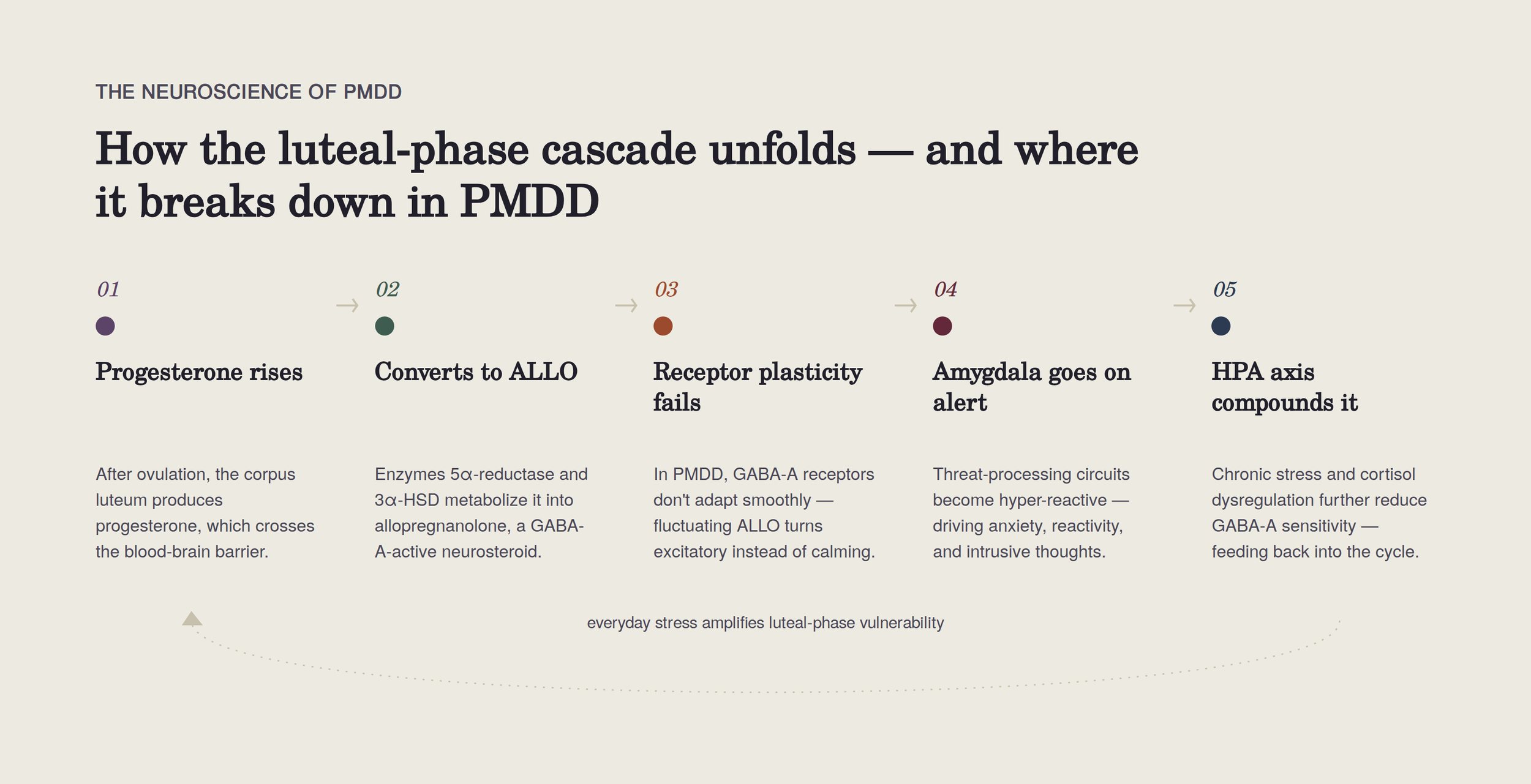
Here's a quick refresher on why that distinction matters clinically. After ovulation, progesterone rises and crosses into the brain, where it's converted into ALLO — a neurosteroid that normally binds to GABA-A receptors and turns up the brain's inhibitory, calming signal. In most people, this keeps mood stable even as hormones shift. In PMDD, GABA-A receptors don't adapt the way they should. Instead of a calming effect, fluctuating ALLO can trigger a paradoxical excitatory response in the amygdala and related threat-processing circuits — which is what drives the disproportionate anxiety, irritability, and emotional reactivity that show up in the luteal phase. Chronic stress and HPA-axis dysregulation compound this further, reducing GABA-A sensitivity even more.
This is why hormone suppression alone often falls short: it doesn't address the receptor sensitivity or the nervous system's threat response underneath it. A protocol that works with this mechanism needs to do two things — support the brain's own calming chemistry, and protect the nervous system's baseline resilience across the cycle.
Understanding the mechanism is the first step. The next question clients usually ask is: "Okay — so what do I actually do about it?"
Below is the framework I use with clients navigating PMDD and severe premenstrual symptoms — targeted nutrient support paired with the foundational lifestyle habits that keep the nervous system resilient across the cycle. This is the same protocol I've built out in my Fullscript dispensary, so you can see exactly what's in it and why.
As always: this is educational information, not a substitute for individualized care. Work with your practitioner before starting anything new, especially if you're pregnant, nursing, or on other medications.
Why Targeted Supplementation Matters Here
Because PMDD symptoms stem from impaired GABA-A receptor plasticity and heightened amygdala reactivity — not from a hormone excess — the goal of supplementation isn't to suppress hormones. It's to:
Support the raw materials the brain needs to produce its own calming neurotransmitters (GABA, serotonin)
Help modulate the rhythm of progesterone production, rather than block it
Buffer the nervous system directly during the highest-vulnerability window — the 10 to 14 days before your period
Here's how that plays out in practice.
Targeted Supplementation
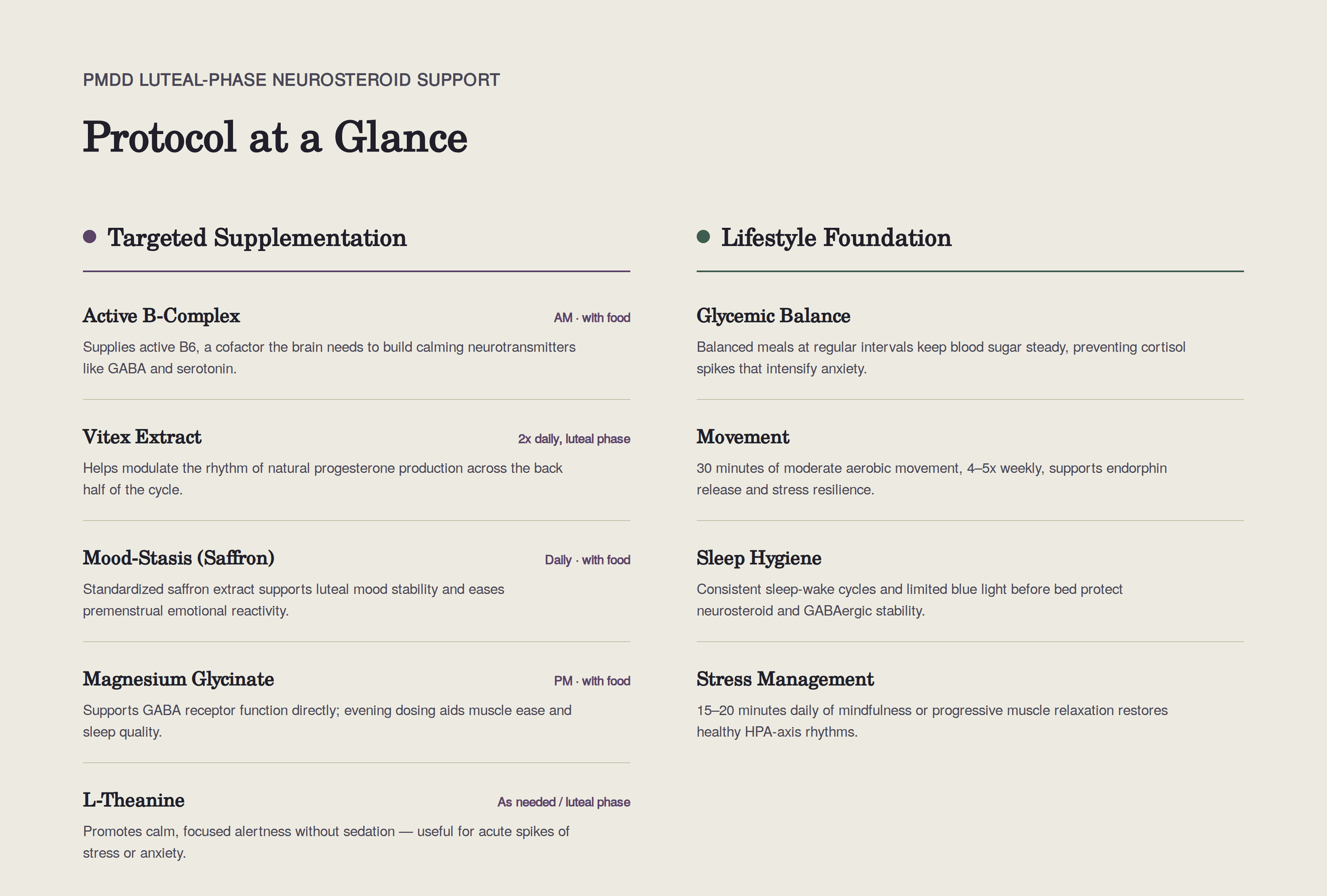
Active B-Complex Vitamin B6 is a required cofactor for converting amino acids into calming neurotransmitters — including GABA and serotonin. An active, bioavailable B-complex ensures your body actually has the raw materials it needs to build these compounds, rather than relying on a form it has to convert first. In this protocol: 1 capsule each morning, with food.
Vitex (Chasteberry) Extract Vitex is one of the better-studied botanicals for supporting smooth, steady progesterone production across the luteal phase. The goal isn't to add more progesterone — it's to help modulate the rhythm of your natural cycle, which may in turn soften the intensity of ALLO fluctuation. In this protocol: 1 capsule twice daily, starting 10–14 days before your period (roughly day 14–18 of a typical cycle).
Mood-Stasis (Saffron Extract) Standardized saffron extract has a growing body of research behind it for luteal-phase mood support — specifically for easing irritability, low mood, and emotional reactivity in the days leading up to menstruation. In this protocol: 1 capsule daily, with food.
Magnesium Glycinate Complex Magnesium is foundational for nervous system regulation — it supports GABA receptor function directly and helps quiet an overactive stress response. The glycinate form is gentle and well-absorbed, and dosing it in the evening does double duty for muscle ease and sleep quality. In this protocol: 2 capsules each evening, with food.
L-Theanine This amino acid promotes a calm, focused state without sedation, by supporting alpha brain wave activity. It's especially useful as an as-needed tool for acute spikes of anxiety or tension — exactly the kind of surge PMDD can produce. In this protocol: 1–2 capsules as needed for acute stress, or 1 capsule in the morning and/or afternoon during the luteal phase.
The Lifestyle Foundation
Supplements support the nervous system — they don't replace the daily habits that keep it stable in the first place. Four areas matter most:
Glycemic Balance (Medical Nutrition Therapy) Balanced meals — complex carbohydrates, healthy fats, and protein at regular intervals — keep blood sugar steady. This matters more than people expect: a blood sugar crash triggers an adrenaline and cortisol response, and that spike can intensify premenstrual anxiety on top of what's already happening neurologically.
Movement Thirty minutes of moderate aerobic movement, four to five times a week, supports endogenous endorphin release and builds stress resilience over time — not just in the moment you're exercising.
Sleep Hygiene Consistent sleep-wake times and limiting blue light for an hour before bed protect your baseline neurosteroid and GABAergic stability. Sleep disruption is one of the fastest ways to destabilize an already-sensitive system.
Stress Management Fifteen to twenty minutes daily of mindfulness-based stress reduction or progressive muscle relaxation helps restore healthy HPA-axis rhythms and cortisol awakening response — directly counteracting the stress-PMDD feedback loop described in the neuroscience behind this condition.
Putting It Together
None of these pieces work in isolation — that's the point. The supplementation supports the biology; the lifestyle habits protect the nervous system's baseline so the supplementation has something stable to build on. Together, they're designed to work across the whole cycle, with extra attention in the 10–14 days before your period, when vulnerability is highest.
Rebalancing nervous system sensitivity takes time. Most clients notice initial shifts within one to two cycles, with fuller results by the third.
Ready to Start?
I've put together this exact protocol — every product, dose, and timing note above — in my Fullscript dispensary, so you can order everything in one place with practitioner guidance built in (with a 15% discount).
View and shop the full PMDD Luteal-Phase Neurosteroid Support protocol →
If you're looking for a more personalized approach — comprehensive functional hormone testing, adrenal profiling, or 1:1 clinical coaching tailored to your unique health picture — click here to fill out a contact form!
To steadier cycles ahead,
Alexa
Certified Nutritionist Specialist
References:
Schellenberg R. Treatment for the premenstrual syndrome with agnus castus fruit extract: prospective, randomised, placebo controlled study. BMJ. 2001;322(7279):134-137. doi:10.1136/bmj.322.7279.134
Verkaik S, Kamperman AM, Van Westrhenen R, Schulte PF. The treatment of premenstrual syndrome with preparations of Vitex agnus castus: a systematic review and meta-analysis. Am J Obstet Gynecol. 2017;217(1):15-20. doi:10.1016/j.ajog.2017.02.028
Agha-Hosseini M, Kashani L, Aleyaseen A, et al. Crocus sativus L. (saffron) in the treatment of premenstrual syndrome: a double-blind, randomised and placebo-controlled trial. BJOG. 2008;115(4):515-519. doi:10.1111/j.1471-0528.2007.01652.x
Wyatt KM, Dimmock PW, Jones PW, O’Brien PMS. Efficacy of vitamin B-6 in the treatment of premenstrual syndrome: systematic review. BMJ. 1999;318(7195):1375-1381. doi:10.1136/bmj.318.7195.1375
De Souza MC, Walker AF, Robinson PA, Bolland K. A synergistic effect of a daily supplement for 1 month of 200 mg magnesium plus 50 mg vitamin B6 for the relief of anxiety-related premenstrual symptoms: a randomized, double-blind, crossover study. J Womens Health Gend Based Med. 2000;9(2):131-139. doi:10.1089/152460900318623
Hidese S, Ogawa S, Ota M, et al. Effects of L-theanine administration on stress-related symptoms and cognitive functions in healthy adults: a randomized controlled trial. Nutrients. 2019;11(10):2362. doi:10.3390/nu11102362
Williams JL, Everett JM, D’Cunha NM, et al. The effects of Green Tea Amino Acid L-Theanine consumption on the ability to manage stress and anxiety levels: a systematic review. Plant Foods Hum Nutr. 2020;75(1):12-23. doi:10.1007/s11130-019-00771-5